§ Quality · Batch consistency · Traceability · Compliance · Packaging

Industrial AI for food and beverage manufacturing.

Food and beverage plants operate under strict food safety regimes — HACCP, FSMA, EU 178/2002 — with batch traceability obligations, perishable raw materials and packaging lines running at high speed. Industrial AI applies computer vision, process analytics and machine learning to quality control, batch consistency, foreign object detection, compliance monitoring and packaging optimization. This page maps the characteristic processes, data sources, AI use case categories and sector-specific constraints so you can evaluate readiness to move from idea to execution.

Tell us what you need. Within 48 h we propose the experts who fit.

Two or three profiles from our network, with availability and indicative terms. No cost, no commitment.

I'm looking for

Thank you. We will match your brief against the network and propose two or three experts within 48 business hours. All conversations are confidential.

Profiles are shared confidentially with you. If nobody in the network fits, we will say so just as quickly. More detail to share? Complete the full brief →

We cover automotive, aerospace, food, pharmaceutical, energy and chemicals. Tell us where you stand and within 48 hours we propose two or three experts with experience in your sector, including availability and indicative terms.

ForFood and beverage manufacturers and co-packers
FocusQuality · Batch consistency · Traceability · Compliance · Packaging
ResponseA shortlist of experts within 48 h
01 Processes & challenges

Characteristic food and beverage processes and where AI meets operational pain.

01

Batch and continuous processing

Mixing, cooking, pasteurization, fermentation and drying operate under tightly controlled temperature and time profiles. Variation in raw material properties — moisture, fat content, pH — shifts the outcome. AI can correlate raw material data with process conditions to predict quality deviations before the batch finishes.

02

Quality control and foreign object detection

Visual defects, fill-level errors, seal integrity and foreign objects — glass, metal, plastic, organic matter — must be caught at production speed. Traditional X-ray and metal detectors have blind spots. Computer vision models trained on X-ray and optical images can catch what they miss, but require careful calibration against false reject rates.

03

Batch consistency and recipe optimization

Consumers expect the same taste, texture and appearance in every unit. Batch-to-batch variation stems from raw material variability, equipment drift and operator adjustments. AI models analyse historical batch data to recommend parameter adjustments that compensate for ingredient variability — without changing the recipe.

04

Traceability and recall readiness

EU 178/2002 and FSMA require traceability one step forward and one step back. A recall must identify affected lots within hours. AI can automate the linking of raw material lots, processing conditions, packaging runs and distribution records into a searchable genealogy graph, reducing recall response time.

05

Packaging line optimization

Filling, capping, labelling and cartoning run at high speed with micro-stops accumulating into significant downtime. AI can analyse PLC cycle data and vision system rejects to identify the root causes of intermittent stoppages and optimize changeover sequences between SKUs.

06

Compliance monitoring at critical control points

HACCP requires monitoring at defined critical control points (CCPs): pasteurization temperature, metal detection, seal integrity. AI can continuously analyse sensor streams against CCP limits and flag drift before a deviation becomes a compliance event, creating an auditable record in the process.

02 Systems & data sources

The data landscape of a food and beverage plant.

SystemRole in the plantData AI can consume
SCADASupervises pasteurizers, cookers, fermenters, dryers and CIP (clean-in-place) systems.Temperatures, flow rates, pressures, CIP cycle durations, valve states — the backbone of CCP monitoring.
MES (Manufacturing Execution System)Manages batch execution, recipe dispatch, packaging orders and genealogy records.Batch IDs, recipe versions, step completion, packaging run data, operator actions, changeover timestamps.
PLC (Programmable Logic Controllers)Controls fillers, cappers, labelers, cartoners and conveyor systems at the packaging line.Cycle counts, fault codes, reject signals, fill-level measurements, cap torque values at unit-level resolution.
LIMS (Laboratory Information Management System)Manages lab test results: microbiological, chemical, physical and sensory quality data.pH, viscosity, moisture, fat content, microbial counts, sensory scores — the ground truth for batch quality models.
ERP (Enterprise Resource Planning)Manages raw material procurement, lot inventory, production planning and distribution.Raw material lot attributes, supplier data, inventory expiry, distribution destinations — input for traceability models.
Historian / process data archiveStores time-series data from sensors across cooking, cooling and packaging.Temperature profiles per batch, CIP chemical concentrations, filler speed profiles — the raw material for process analytics.
QMS (Quality Management System)Records nonconformances, deviations, CAPA (corrective and preventive actions) and audit findings.Defect types, deviation records, root cause categories, CAPA status — feedback loop for quality prediction models.
Vision and X-ray inspection systemsIn-line optical and X-ray inspection at packaging: fill level, seal integrity, foreign object detection.Inspection images, reject classifications, confidence scores — training data for vision-based quality models.
03 AI use case categories

Where machine learning maps onto food and beverage operations.

01

Vision-based quality and foreign object detection

Deep learning models on optical and X-ray images to detect foreign objects, visual defects, fill-level errors and seal integrity issues at line speed. Conceptual example: a CNN trained on 80,000 X-ray images of filled jars detects glass fragments down to 2 mm at 1,200 units per minute with a false reject rate below 0.3%.

02

Batch consistency prediction

Regression models that correlate raw material properties, process conditions and lab results to predict final product quality before the batch completes. Conceptual example: a model combining NIR moisture data, cooker temperature profiles and LIMS viscosity results predicts batch viscosity within 2% of lab-measured value, enabling mid-batch correction.

03

Automated traceability and recall acceleration

Graph-based models that link raw material lots, batch records, packaging runs and distribution data into a searchable genealogy. Conceptual example: a traceability graph built from ERP lot data, MES batch genealogy and warehouse records narrows a recall scope from 48 hours of production to 2 hours of affected lots.

04

Critical control point monitoring and drift detection

Anomaly detection models on SCADA and historian data that flag drift in CCP parameters — pasteurization temperature, CIP chemical concentration — before they breach HACCP limits. Conceptual example: a streaming anomaly model on pasteurizer temperature detects a 0.4°C drift trend 20 minutes before the lower control limit is reached.

05

Packaging line micro-stop analysis

Models that analyse PLC fault codes, cycle data and vision rejects to identify root causes of intermittent packaging stoppages. Conceptual example: a clustering model on filler fault codes identifies a recurring 0.8-second micro-stop linked to a specific cap feeder, enabling targeted maintenance.

06

Demand-driven production scheduling

Forecasting models that combine ERP order data, historical demand patterns and shelf-life constraints to optimize production sequencing. Conceptual example: a demand model recommends producing shorter runs of high-perishability SKUs closer to dispatch, reducing waste by 6% while maintaining fill rate.

04 Sector constraints

What constrains AI in food and beverage manufacturing.

ConstraintWhat it means for AI initiatives
Food safety regulationHACCP, FSMA Preventive Controls, EU 178/2002 and sector-specific standards (e.g. BRCGS, IFS, FSSC 22000) define mandatory controls. AI that monitors or influences CCPs must complement — not bypass — these validated procedures. Any AI-driven process change requires revalidation of the HACCP plan.
Traceability obligationOne-up/one-down traceability is mandatory. AI systems that touch batch records, packaging data or distribution must preserve the regulatory chain and produce audit-ready records on demand.
Batch releaseMany food products require hold-and-release: a batch cannot ship until lab results confirm compliance. AI predictions cannot replace the lab test for release, but can prioritize which batches to test and flag those at risk of failing.
Perishability and shelf lifeRaw materials and finished goods have limited shelf life. AI scheduling and inventory models must respect expiry constraints and first-expired-first-out (FEFO) logic, not just optimize for throughput.
Hygiene and cleanabilityCIP cycles and hygienic design constraints apply to any physical sensor or edge device added to the line. AI deployment must not compromise cleanability or introduce contamination risk.
Allergen managementCross-contamination with allergens is a critical risk. AI models that influence production sequencing must account for allergen changeover protocols and cannot recommend sequences that increase cross-contact risk.
05 Readiness criteria

When a food and beverage AI initiative is ready to move from idea to execution.

01

Data availability across systems

SCADA, MES, LIMS and ERP data are accessible and can be joined on batch or lot identifiers. Historical depth covers seasonal variation (typically 12+ months). Data from vision and X-ray systems is exportable, not locked in vendor silos.

02

Defined quality or compliance metric

The initiative targets a measurable outcome: false reject rate on inspection, reduction in batch variability, recall response time, or reduction in CCP deviations per thousand batches.

03

Regulatory alignment confirmed

The food safety team has reviewed the initiative and confirmed that AI augmentation does not bypass HACCP, FSMA or certification requirements. The validation path for any process change is defined.

04

Integration with existing quality workflow

There is a clear path for how AI outputs reach operators, lab teams and the QMS — whether as a dashboard alert, a batch release recommendation flag, or an automated traceability record.

Type of professional support organizations typically need: an AI architect who understands food safety regulations and OT/IT integration in hygienic environments, a project leader with experience deploying vision systems on high-speed packaging lines, and — for vendor assessment — an independent expert who can evaluate inspection platforms against BRCGS, IFS or FSSC 22000 requirements. For executive teams defining an AI roadmap, a board advisor with food industry experience grounds the strategy in compliance reality. See consulting, project leadership, board advisory and due diligence.

06 Frequently asked questions

About industrial AI in food and beverage manufacturing.

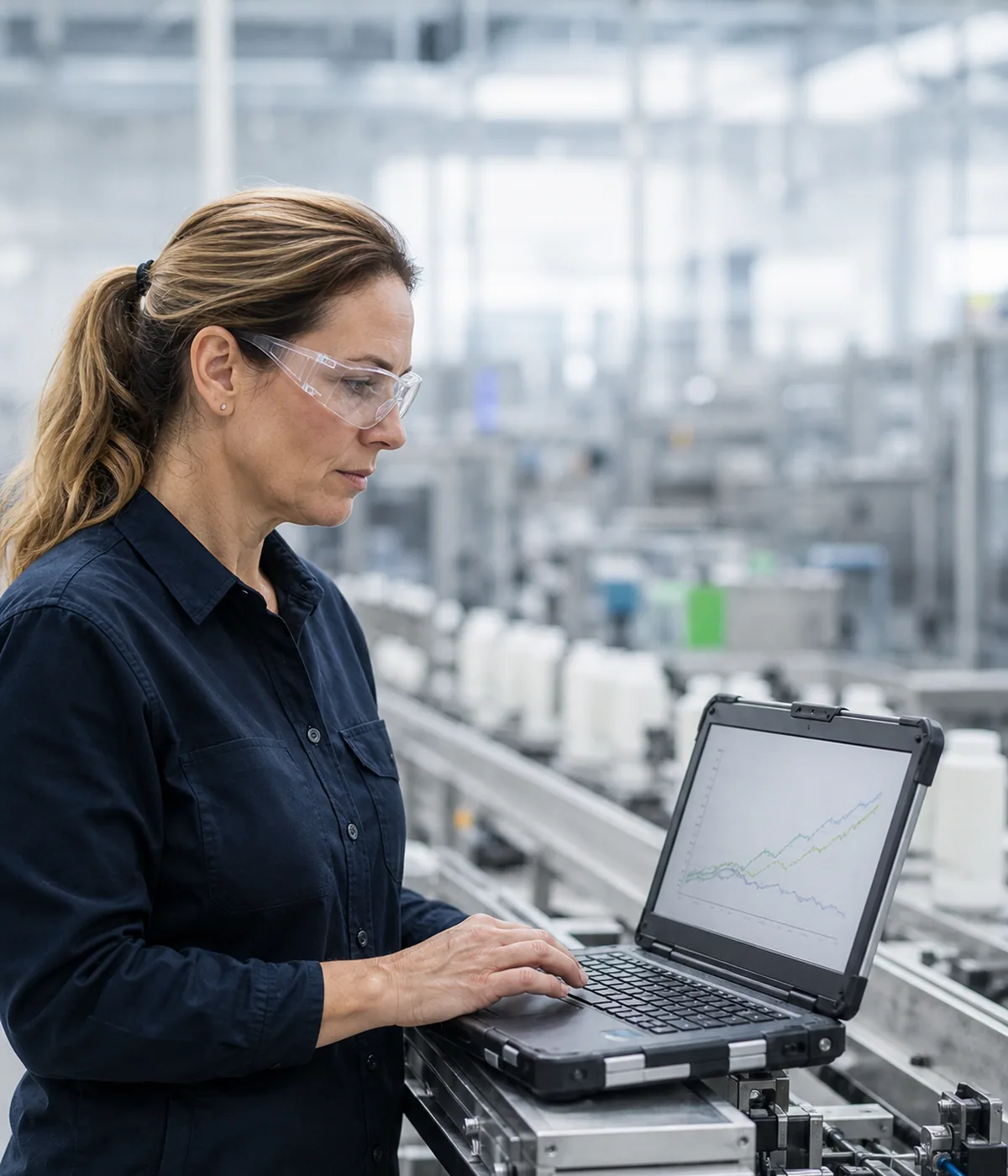
Engineer reviewing production data beside an automated manufacturing line.
How does AI help with HACCP and FSMA compliance?

AI does not replace HACCP or FSMA procedures. It augments them by continuously monitoring critical control points with sensor data and computer vision, flagging deviations before they become compliance events, and creating automated traceability records that link every batch to its raw materials, process parameters and packaging run.

Can AI detect foreign objects on a high-speed packaging line?

Yes. Computer vision models trained on X-ray and optical images can detect glass shards, metal fragments, plastic and organic foreign matter at line speeds exceeding 1000 units per minute. The key challenge is balancing false reject rates against detection sensitivity, and integrating the reject mechanism with the packaging PLC.

What data from a food plant is most useful for AI?

The most valuable data comes from SCADA for process temperatures and flow rates, the historian for batch profiles, the LIMS for lab test results, the ERP for raw material lot tracking, and the MES for batch genealogy and packaging run records.

How does AI handle recipe and batch consistency in food manufacturing?

Models analyse historical batch data — ingredient properties, processing conditions and final product specifications — to identify which parameter combinations correlate with quality deviations. The output is a set of recommended setpoint adjustments for the next batch, not a change to the recipe itself.

07 Request experts

Tell us where you stand.

Your plant, your challenge and the stage of the project. That is enough for us to prepare the proposal.

I would rather send a detailed brief

Related services: Consulting · Project leadership · Board advisory · Due diligence · Forward-deployed experts · Executive workshops

Other industries: Automotive · Pharmaceutical · Energy · Aerospace · Chemical

Guides: AI roadmap · Project ROI · Pilot to production · Architecture (MES, SCADA, edge, generative AI)

Tell us what you need. Within 48 h we propose the experts who fit.

Two or three profiles from our network, with availability and indicative terms. No cost, no commitment.

I'm looking for

Thank you. We will match your brief against the network and propose two or three experts within 48 business hours. All conversations are confidential.

Profiles are shared confidentially with you. If nobody in the network fits, we will say so just as quickly. More detail to share? Complete the full brief →