§ GMP · Batch release · Process validation · Contamination · Supply chain

Industrial AI for pharmaceutical manufacturing.

Pharmaceutical manufacturing operates under the most stringent regulatory framework in industry — GMP, ICH Q9/Q10, EU Annex 1/11, FDA 21 CFR Part 11 — with every batch requiring validated process control, documented quality release and full traceability. Industrial AI applies machine learning, anomaly detection and process analytics to batch monitoring, continued process verification, contamination detection and supply chain integrity. This page maps the characteristic processes, data sources, AI use case categories and regulatory constraints specific to pharma manufacturing, so you can evaluate where an initiative is ready to move from idea to execution.

Tell us what you need. Within 48 h we propose the experts who fit.

Two or three profiles from our network, with availability and indicative terms. No cost, no commitment.

I'm looking for

Thank you. We will match your brief against the network and propose two or three experts within 48 business hours. All conversations are confidential.

Profiles are shared confidentially with you. If nobody in the network fits, we will say so just as quickly. More detail to share? Complete the full brief →

We cover automotive, aerospace, food, pharmaceutical, energy and chemicals. Tell us where you stand and within 48 hours we propose two or three experts with experience in your sector, including availability and indicative terms.

ForPharma manufacturers and CDMOs
FocusGMP · Batch release · Validation · Contamination · Supply chain
ResponseA shortlist of experts within 48 h
01 Processes & challenges

Characteristic pharma processes and where AI meets operational pain.

01

API synthesis and crystallization control

Active pharmaceutical ingredient synthesis involves multi-step reactions with tight control of temperature, pressure, stoichiometry and crystallization conditions. Variation in raw material purity or process parameters shifts yield, polymorphic form and impurity profile. AI can correlate multivariate process data with CQA outcomes to predict quality deviations during the batch.

02

Sterile fill-finish manufacturing

Aseptic filling, lyophilization and stoppering in Grade A environments under Annex 1 requires continuous environmental monitoring and operator discipline. Contamination events are rare but catastrophic. AI can analyse environmental monitoring trends — particle counts, microbial data, HVAC parameters — to flag conditions that precede contamination.

03

Solid dosage formulation and tableting

Granulation, drying, blending, compression and coating must achieve uniform content, dissolution profile and tablet hardness. Blend uniformity and content uniformity are CQAs. AI can analyse blend and compression data — NIR spectra, force profiles, weight — to predict out-of-specification tablets before the batch completes.

04

Batch release and electronic batch records

Every batch requires review of electronic batch records (EBR) against specifications before release. The QP must verify process parameters, lab results, deviations and environmental data. AI can aggregate and structure the release dossier, flag anomalies and reduce review cycle time — but the certification decision remains with the QP.

05

Process validation and continued process verification

ICH Q8/Q9/Q10 define a lifecycle approach: Stage 1 (process design), Stage 2 (qualification), Stage 3 (continued process verification). Stage 3 requires ongoing statistical monitoring of CPPs and CQAs. AI can perform continuous multivariate monitoring, detecting drift that univariate control charts miss.

06

Supply chain integrity and cold chain

Pharma supply chains must ensure product integrity from API to patient, with cold chain monitoring for biologics and temperature-sensitive products. Serialization and track-and-trace add data volume. AI can monitor temperature logger data, predict cold chain risk and flag anomalies in the serialization data that may indicate diversion.

02 Systems & data sources

The data landscape of a pharmaceutical plant.

SystemRole in the plantData AI can consume
DCS / SCADAControls reactors, crystallizers, dryers, granulators and HVAC for cleanrooms. DCS is dominant in API; SCADA in packaging.Process temperatures, pressures, flow rates, agitation speeds, pH — the CPPs that define batch trajectory.
MES (Manufacturing Execution System)Manages batch execution, electronic batch records (EBR), recipe dispatch and weigh-and-dispense verification.Batch IDs, recipe versions, step timestamps, operator signatures, material lot assignments, yield at each step.
LIMS (Laboratory Information Management System)Manages analytical testing: assay, impurity, dissolution, identity, microbiological results.CQA test results, release specifications, out-of-specification flags, stability data — ground truth for quality models.
Historian / process data archiveStores high-resolution time-series from DCS/SCADA for batch analysis and regulatory review.Temperature profiles per batch, pressure curves, NIR spectra streams — raw material for multivariate models.
QMS (Quality Management System)Manages deviations, CAPA, change control, OOS investigations and audit findings.Deviation records, root cause categories, CAPA status, change control impact assessments — feedback loop for predictive quality.
ERP (Enterprise Resource Planning)Manages material procurement, production planning, serialization and distribution.Raw material lot data, supplier certificates, inventory status, serialization aggregation, distribution chain records.
EMS (Environmental Monitoring System)Monitors cleanroom conditions: viable and non-viable particle counts, differential pressure, temperature, humidity.Particle count trends, pressure differentials, microbial sample results — critical for sterile manufacturing AI.
Patrol / building automation (BMS)Controls HVAC, water systems (WFI, purified water) and cleanroom pressure cascades.HVAC performance data, WFI conductivity and TOC, pressure cascade status — context for contamination risk models.
03 AI use case categories

Where machine learning maps onto pharmaceutical operations.

01

Continued process verification with multivariate monitoring

PCA or PLS models on historian batch data that monitor the process trajectory in real time against the validated multivariate space. Conceptual example: a PCA model on reactor temperature, pressure and feed rate detects a batch moving outside the Stage 2 validated envelope 30 minutes before the CQA is tested.

02

Predictive batch quality

Regression models that combine in-process data — NIR spectra, temperature profiles, pressure curves — with historical LIMS results to predict final CQA before lab testing completes. Conceptual example: a PLS model on in-line NIR data predicts tablet dissolution within 3% of the lab-measured value 2 hours before the dissolution test finishes.

03

Environmental monitoring anomaly detection

Anomaly detection models on EMS and BMS data that flag trends in particle counts, pressure cascades or microbial data that precede contamination events. Conceptual example: a streaming anomaly model on Grade A particle counts detects a 12-hour upward trend in 0.5 µm particles, triggering preventive intervention before an action limit breach.

04

Batch record review acceleration

NLP and rule-based models that scan EBR data for deviations, missing entries, and out-of-range values, structuring the release dossier for QP review. Conceptual example: an automated batch review flags 3 anomalies across 400 data points in a fill-finish batch, reducing QP dossier preparation from 4 hours to 45 minutes.

05

Cold chain and supply chain integrity monitoring

Models that analyse temperature logger data, shipment records and serialization events to predict cold chain excursions and flag anomalies that may indicate diversion. Conceptual example: a model on temperature logger data from a biologics shipment predicts a 2°C drift trend 6 hours before the upper limit, enabling rerouting.

06

Deviation pattern analysis and CAPA prioritization

Clustering models on QMS deviation records that identify recurring patterns across batches, lines and products, enabling data-driven CAPA prioritization. Conceptual example: a topic model on 2,000 deviation records clusters 15% into a recurring weigh-and-dispense error pattern linked to a specific raw material supplier.

04 Sector constraints

What constrains AI in pharmaceutical manufacturing.

ConstraintWhat it means for AI initiatives
GMP validationAny AI system that influences a GMP-regulated process must be validated under GAMP 5 and Annex 11 / 21 CFR Part 11. This includes computer system validation (CSV), data integrity (ALCOA+), and defined change control. AI models are not exempt — they require the same validation rigor as any computerized system.
Process validation lifecycleICH Q8/Q9/Q10 define the three-stage validation lifecycle. AI that monitors or controls CPPs must operate within the validated design space. Moving a model from monitoring to control requires formal change control and requalification.
Batch release accountabilityUnder EU GMP Annex 16, the QP has personal legal responsibility for batch certification. AI can inform the release dossier but cannot make the certification decision. The system architecture must preserve the QP's ability to review and override.
Sterile manufacturing (Annex 1)The revised EU GMP Annex 1 emphasizes contamination control strategy (CCS) and requires continuous monitoring of Grade A environments. AI that monitors environmental data must be part of the documented CCS, not an informal overlay.
Data integrity (ALCOA+)All data generated or processed by AI systems must meet ALCOA+ principles — attributable, legible, contemporaneous, original, accurate, plus complete, consistent, enduring and available. Model inputs, outputs and audit trails are in scope.
Regulatory inspection readinessAI systems must be inspectable. FDA, EMA and other authorities may request model documentation, training data provenance, validation results and change history. The system must produce these on demand.
Supply chain serializationSerialization and track-and-trace requirements (DSCSA, EU FMD) add data volume and complexity. AI models that touch supply chain data must operate within the serialized data architecture and not break regulatory reporting chains.
05 Readiness criteria

When a pharma AI initiative is ready to move from idea to execution.

01

Validated data sources

The DCS/SCADA, historian, MES, LIMS and QMS data are accessible, time-synchronized and meet ALCOA+ principles. Historical depth covers enough batches to capture process variability — typically 50+ batches for the target product.

02

Defined CQA or process metric

The initiative targets a measurable CQA or process outcome: prediction of dissolution, reduction in OOS events, earlier detection of process drift, or reduction in batch record review time.

03

GMP validation path defined

The quality team has confirmed the validation approach: GAMP 5 categorization, CSV plan, data integrity assessment, and change control procedure. The AI system's role — monitoring vs. advisory vs. control — is clearly defined.

04

Inspection documentation plan

Model documentation, training data provenance, validation results and change history are structured for regulatory inspection. The system can produce these on demand for FDA, EMA or other authority review.

Type of professional support organizations typically need: an AI architect who understands GMP, GAMP 5 and data integrity requirements, a project leader with experience deploying ML models in a validated pharma environment, and — for vendor assessment — an independent expert who can evaluate platform proposals against Annex 11, 21 CFR Part 11 and ICH Q9/Q10. For executive committees defining an AI strategy, a board advisor with pharma manufacturing experience aligns the roadmap with regulatory reality. See consulting, project leadership, board advisory and due diligence.

06 Frequently asked questions

About industrial AI in pharmaceutical manufacturing.

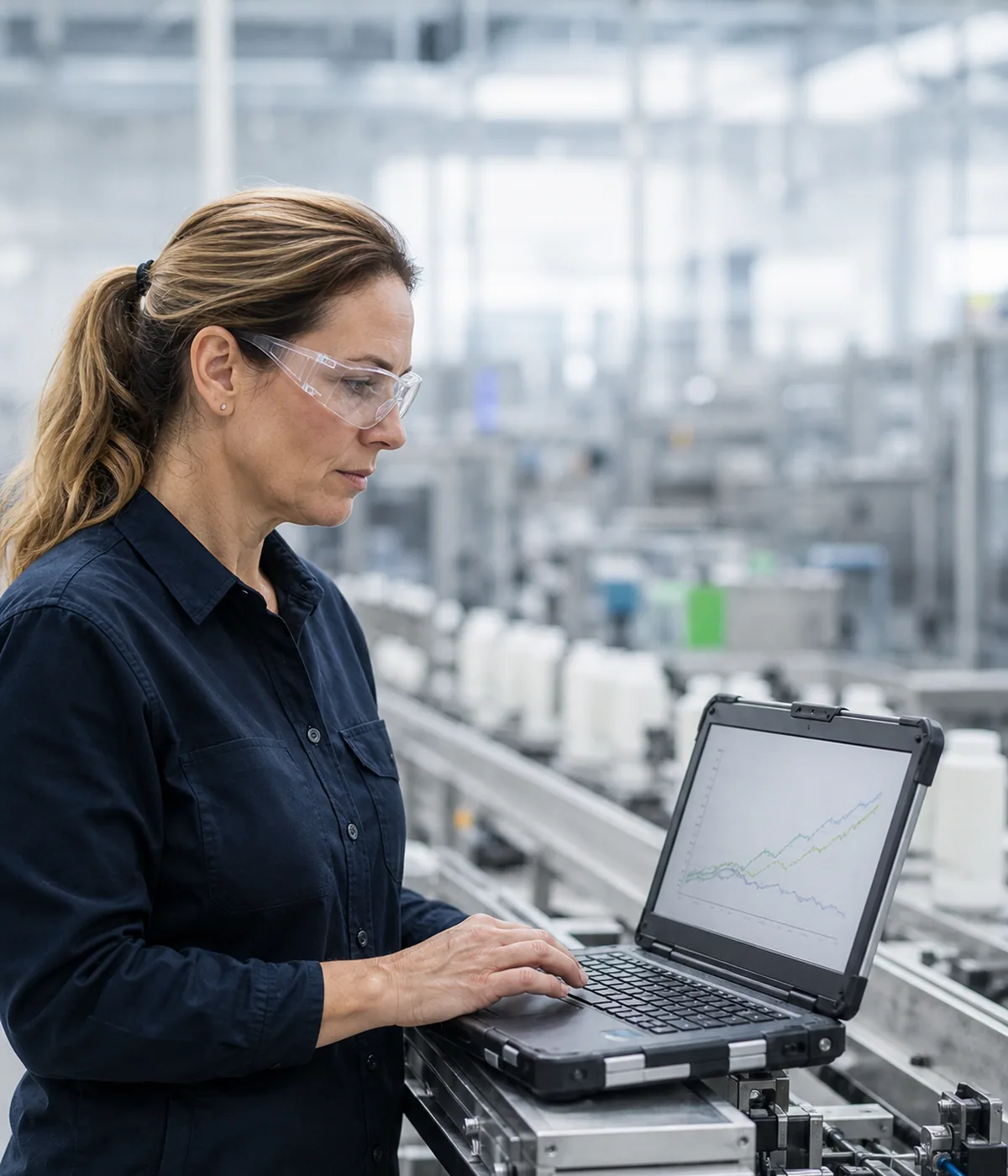
Engineer reviewing production data beside an automated manufacturing line.
Can AI replace the Qualified Person in batch release?

No. Under EU GMP Annex 16, the Qualified Person (QP) bears personal legal responsibility for batch certification. AI can aggregate batch records, flag anomalies and present a structured release dossier, but the certification decision remains with the QP. AI accelerates the preparation; it does not replace the accountability.

How does AI fit into GMP process validation?

AI does not change the validation framework — Stage 1 (design), Stage 2 (qualification), Stage 3 (continued process verification). It can strengthen Stage 3 by continuously monitoring CPP and CQA trends, detecting drift earlier than periodic statistical review, and flagging when the process is moving out of the validated state.

What data sources are most relevant for pharma AI initiatives?

The most critical sources are the DCS/SCADA for process parameters, the historian for batch time-series profiles, the LIMS for analytical and release test results, the MES for batch execution records and electronic batch records, and the QMS for deviations, CAPA and change control records.

Can AI be used for contamination detection in sterile manufacturing?

Yes, as a monitoring layer. Environmental monitoring data — viable and non-viable particle counts, surface swabs, air sampler results — can be analysed by anomaly detection models to flag trends that precede contamination events. The models do not replace microbiological testing but can prioritize sampling and alert earlier than threshold alarms alone.

What regulatory documents govern AI in pharma manufacturing?

ICH Q9 (Quality Risk Management), ICH Q10 (Pharmaceutical Quality System), EU GMP Annex 1 (sterile manufacturing), Annex 11 (computerized systems), and FDA 21 CFR Part 11 (electronic records). ICH Q13 introduces continuous manufacturing, which is particularly relevant for AI-enabled process control.

07 Request experts

Tell us where you stand.

Your plant, your challenge and the stage of the project. That is enough for us to prepare the proposal.

I would rather send a detailed brief

Related services: Consulting · Project leadership · Board advisory · Due diligence · Forward-deployed experts · Executive workshops

Other industries: Automotive · Food & beverage · Energy · Aerospace · Chemical

Guides: AI roadmap · Project ROI · Pilot to production · Architecture (MES, SCADA, edge, generative AI)

Tell us what you need. Within 48 h we propose the experts who fit.

Two or three profiles from our network, with availability and indicative terms. No cost, no commitment.

I'm looking for

Thank you. We will match your brief against the network and propose two or three experts within 48 business hours. All conversations are confidential.

Profiles are shared confidentially with you. If nobody in the network fits, we will say so just as quickly. More detail to share? Complete the full brief →