§ Assembly · Quality · Supply chain · Maintenance · Robotics

Industrial AI for automotive manufacturing.

Automotive plants run on synchronized assembly lines, robotic cells, just-in-sequence supply and tight quality gates. Industrial AI applies machine learning, computer vision and predictive analytics across these processes — from detecting paint defects in real time to predicting robot failures before they stop the line. This page maps the characteristic processes, data sources, AI use case categories and constraints specific to automotive manufacturing, so you can evaluate where an initiative is ready to move from idea to execution.

Tell us what you need. Within 48 h we propose the experts who fit.

Two or three profiles from our network, with availability and indicative terms. No cost, no commitment.

I'm looking for

Thank you. We will match your brief against the network and propose two or three experts within 48 business hours. All conversations are confidential.

Profiles are shared confidentially with you. If nobody in the network fits, we will say so just as quickly. More detail to share? Complete the full brief →

We cover automotive, aerospace, food, pharmaceutical, energy and chemicals. Tell us where you stand and within 48 hours we propose two or three experts with experience in your sector, including availability and indicative terms.

ForAutomotive manufacturers and Tier 1 suppliers
FocusAssembly · Quality · Supply chain · Maintenance · Robotics
ResponseA shortlist of experts within 48 h
01 Processes & challenges

Characteristic automotive processes and where AI meets operational pain.

01

Body-in-white and assembly line synchronization

Stamping, welding, painting and final assembly run as a synchronized chain. A stop at any station cascades downstream. AI can predict station-level bottlenecks and optimize sequencing, but the data must bridge MES, ANDON systems and PLC cycle times in real time.

02

Quality inspection at line speed

Paint defects, weld integrity, gap-and-flush measurements and surface scratches must be caught at production tempo. Manual inspection is inconsistent and slow. Computer vision models can flag defects in milliseconds, but they need calibrated cameras, controlled lighting and integration with the QMS.

03

Supply chain and just-in-sequence delivery

Automotive supply chains span hundreds of Tier 1 and Tier 2 suppliers delivering in sequence to the line. Disruptions propagate fast. AI can forecast supplier risk and optimize inbound logistics, but requires ERP data, supplier delivery records and sometimes external signals like weather or port congestion data.

04

Predictive maintenance for presses, robots and conveyors

Unplanned downtime on a stamping press or welding robot costs thousands per minute. Vibration, temperature and current signatures from historians hold early warning signals. Predictive models can flag bearing degradation or servo drift weeks before failure, but only if the historian has sufficient resolution and the maintenance workflow can act on the alerts.

05

Robotics integration and adaptive control

Modern automotive plants use hundreds of industrial robots for welding, handling, painting and assembly. AI-enhanced adaptive control can compensate for part variability and tool wear, but integrating ML inference into robot controllers requires careful validation and often edge computing close to the cell.

06

Paint shop energy and process optimization

Paint shops are among the most energy-intensive areas in an automotive plant. Oven temperature profiles, booth humidity and air recirculation settings are interdependent. AI can optimize setpoints for energy reduction while maintaining coating quality, but the models must respect validated process windows defined by paint suppliers.

02 Systems & data sources

The data landscape of an automotive plant.

SystemRole in the plantData AI can consume
MES (Manufacturing Execution System)Manages production orders, work instructions, traceability and ANDON escalations across the line.Cycle times, station status, stoppage reasons, work-in-progress tracking, genealogy of parts and assemblies.
SCADASupervises line-level operations: conveyor speeds, robotic cell coordination, paint booth parameters.Real-time process values, alarm logs, setpoint vs. actual deviations across stations.
PLC (Programmable Logic Controllers)Controls individual machines and robots: welding controllers, stamping presses, transfer mechanisms.I/O states, cycle counters, fault codes, torque curves, positioning data at millisecond resolution.
Historian / process data archiveStores time-series data from sensors and controllers over long periods for analysis and compliance.Vibration spectra, motor current signatures, temperature profiles, pressure curves — the raw material for predictive models.
ERP (Enterprise Resource Planning)Manages supply chain, inventory, production planning and supplier orders (typically SAP or Oracle).Supplier delivery performance, inventory levels, order changes, build schedules that feed into line sequencing.
QMS (Quality Management System)Records defects, nonconformances, rework orders, audit results and supplier quality ratings.Defect codes by station and part, rework rates, root-cause categories, first-pass-yield trends.
ANDON systemOperator-triggered line stop and escalation: alerts when a problem is detected at a workstation.Stoppage frequency, duration, root cause, station — context for bottleneck prediction models.
03 AI use case categories

Where machine learning maps onto automotive operations.

01

Visual quality inspection

Deep learning models trained on images of painted bodies, welded joints and assembled components to detect defects that human inspectors miss at line speed. Conceptual example: a CNN trained on 50,000 paint surface images flags orange-peel and runs at 60 parts per minute on an edge GPU at the booth exit.

02

Predictive maintenance on critical assets

Time-series models on historian data to predict remaining useful life of bearings, servo motors and hydraulic systems on presses and robots. Conceptual example: an LSTM model on vibration spectra from a stamping press predicts bearing failure 14 days in advance with a defined false-alarm threshold.

03

Line bottleneck prediction and sequencing optimization

Models that combine MES cycle-time data, ANDON stoppage history and ERP build schedules to predict where the line will bottleneck and suggest sequencing adjustments. Conceptual example: a gradient-boosted model predicts station-level throughput degradation 2 hours ahead, triggering preventive ANDON review.

04

Supply chain risk forecasting

Machine learning on supplier delivery records, ERP inventory data and external signals to predict disruption risk and recommend buffer adjustments. Conceptual example: a model combining Tier 1 delivery history with weather and logistics data flags a 30% probability of a 2-day delay on a critical component.

05

Adaptive robotic process control

Reinforcement learning or model-predictive control that adjusts robot trajectories or welding parameters in real time to compensate for part variability and tool wear. Conceptual example: an adaptive weld controller adjusts current and dwell time per spot based on resistance feedback, reducing spatter and improving weld strength consistency.

06

Energy and process optimization in the paint shop

Optimization models that find the best combination of oven temperatures, booth humidity and air recirculation to minimize energy use while staying within validated coating process windows. Conceptual example: a model-based optimizer reduces oven gas consumption by 8% by dynamically adjusting zone setpoints to part load.

04 Sector constraints

What constrains AI in automotive manufacturing.

ConstraintWhat it means for AI initiatives
Line availabilityAssembly lines run at 85–95% OEE targets. Any AI system that touches the control layer must not introduce latency or risk unplanned stops. Pilots run in shadow mode before any operational change.
Quality validationPPAP (Production Part Approval Process) and IATF 16949 require documented process changes. AI-driven inspection or control changes must go through the same validation gates as any process modification.
SafetyISO 10218 and ISO/TS 15066 govern collaborative robot safety. AI models that influence robot motion must be validated against these standards. Functional safety (ISO 13849) applies to any AI output that triggers a safety function.
TraceabilityEvery vehicle has a build record linking parts, processes and parameters to its VIN. AI systems that influence quality or process must log their decisions in a way that is traceable to the vehicle genealogy in the MES.
CybersecurityOT/IT convergence exposes PLCs and SCADA to network threats. AI inference at the edge must comply with the plant's segmentation and endpoint security policies.
Supplier integrationJust-in-sequence delivery means AI predictions about supply chain risk must be actionable within the supplier's lead time, not after parts are already in transit.
05 Readiness criteria

When an automotive AI initiative is ready to move from idea to execution.

01

Data availability and quality

The relevant historian, MES and QMS data exists, is accessible, and has enough resolution and history (typically 12+ months) to train or validate a model. Data gaps and calibration drift have been identified.

02

Defined operational metric

The initiative targets a measurable outcome: false-call rate on inspection, mean time to detect a defect, reduction in unplanned downtime minutes, or energy reduction in kWh per vehicle.

03

Integration path identified

There is a clear architecture for how model outputs reach the people or systems that act on them — whether that is an operator dashboard, a QMS record or a maintenance work order.

04

Validation and rollback plan

The initiative has a defined shadow-mode period, success thresholds for go/no-go, and a rollback path that does not disrupt line operations if the model underperforms.

Type of professional support organizations typically need: an AI architect who understands OT/IT integration in automotive plants, a project leader with experience taking vision or predictive models from pilot to production on a live line, and — for vendor selection — an independent expert who can evaluate platform proposals against IATF 16949 and functional safety requirements. For executive committees defining an AI roadmap, a board advisor with plant-floor experience grounds the strategy in operational reality. See consulting, project leadership, board advisory and due diligence.

06 Frequently asked questions

About industrial AI in automotive manufacturing.

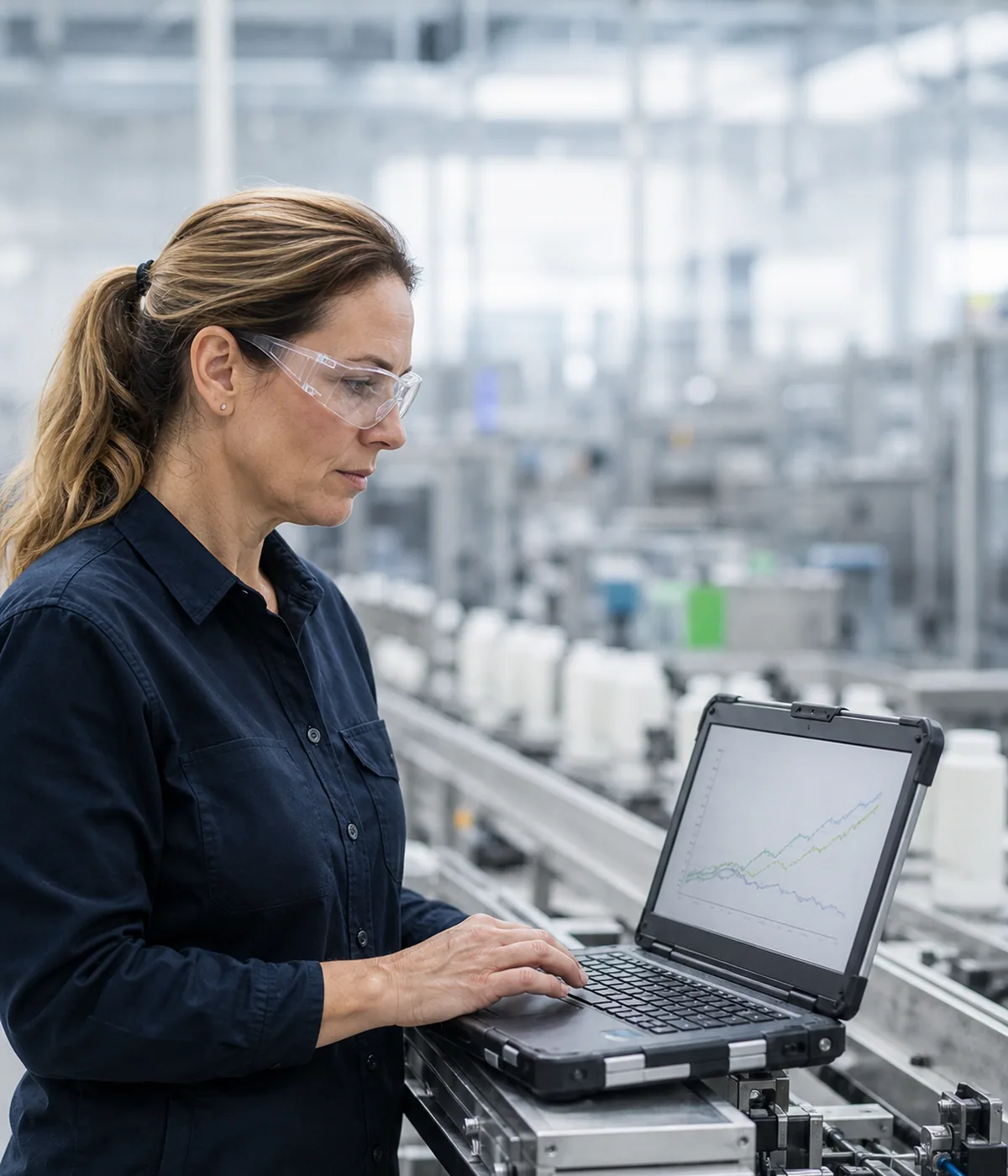
Engineer reviewing production data beside an automated manufacturing line.
Where does AI deliver the most value in an automotive plant?

The highest-impact areas are typically quality inspection on high-speed lines, predictive maintenance on critical assets like presses and robots, and supply chain synchronization across tiered suppliers. The specific priority depends on where the plant has the most data and the most costly downtime.

Can AI be deployed without halting the assembly line?

Yes, if the architecture is designed for it. Computer vision inspection can run in parallel to existing quality checks, and predictive maintenance models consume data from historians without touching the control layer. However, any change to PLC logic or robot programming requires validated testing windows.

What data sources are needed for automotive AI initiatives?

The most relevant sources are MES for production orders and traceability, SCADA and PLCs for machine-level signals, historians for time-series vibration and temperature data, ERP for supply chain and inventory context, and QMS for defect and nonconformance records.

How long does it take to move from a quality inspection pilot to production?

A well-scoped visual inspection pilot on a single line can validate in 8 to 12 weeks. Moving to production across multiple lines depends on infrastructure readiness, integration with the QMS, and operator training. The most common delay is not model accuracy but integration with existing quality workflows.

Does AI replace robotic automation already in place?

No. AI complements existing robotics by adding adaptive control, anomaly detection and predictive maintenance. The robots and PLCs remain the execution layer; AI operates as an optimization and monitoring layer above them.

07 Request experts

Tell us where you stand.

Your plant, your challenge and the stage of the project. That is enough for us to prepare the proposal.

I would rather send a detailed brief

Related services: Consulting · Project leadership · Board advisory · Due diligence · Forward-deployed experts · Executive workshops

Other industries: Food & beverage · Pharmaceutical · Energy · Aerospace · Chemical

Guides: AI roadmap · Project ROI · Pilot to production · Architecture (MES, SCADA, edge, generative AI)

Tell us what you need. Within 48 h we propose the experts who fit.

Two or three profiles from our network, with availability and indicative terms. No cost, no commitment.

I'm looking for

Thank you. We will match your brief against the network and propose two or three experts within 48 business hours. All conversations are confidential.

Profiles are shared confidentially with you. If nobody in the network fits, we will say so just as quickly. More detail to share? Complete the full brief →